Arabic dialects — the complete guide (Levantine, Egyptian, Gulf, Maghrebi & more)
A practical, non-academic guide to the Arabic dialect landscape — written by a native Lebanese teacher. What each family sounds like, where it's spoken, and how they relate to each other.
"Arabic" is not a single language — it's a family of related spoken dialects, plus a shared written standard (Modern Standard Arabic / MSA). The dialects diverged over centuries the way Romance languages diverged from Latin: Italian, Spanish and French all descend from Latin, but a Roman and a Parisian don't chat in Latin. Same idea. Below is the map, region by region.
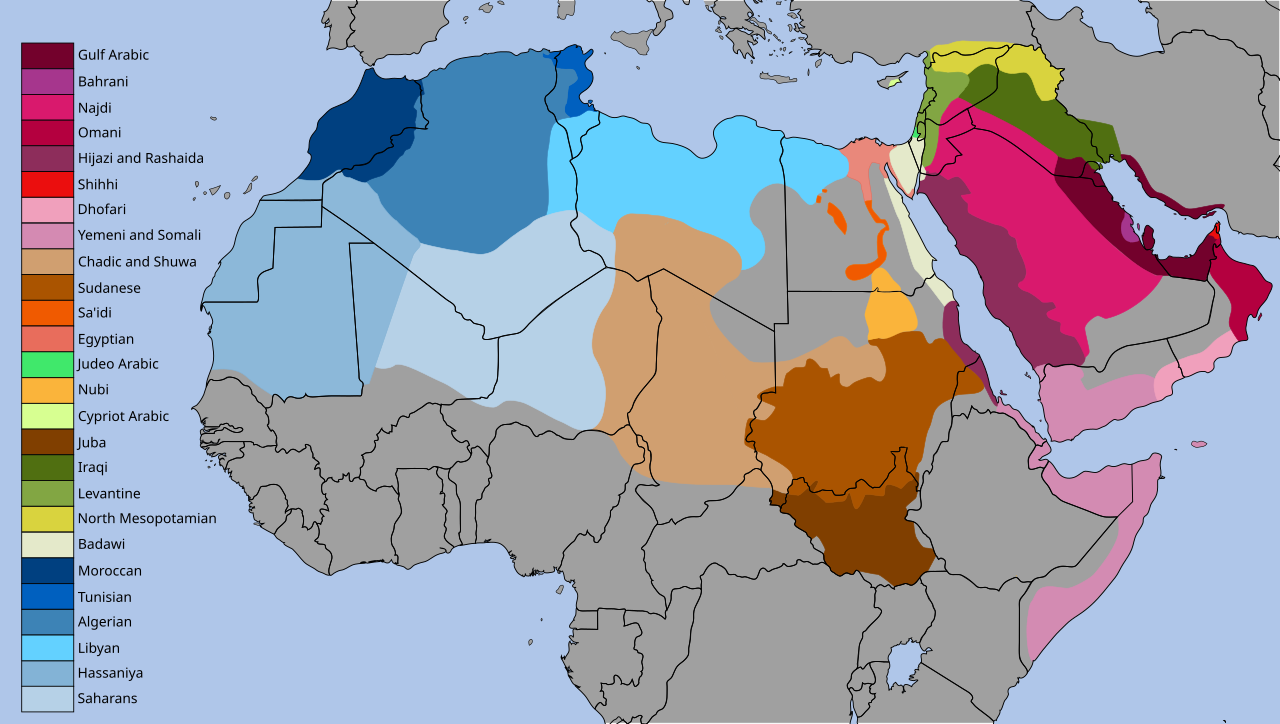
1. Levantine Arabic (Shami)
Spoken across the Eastern Mediterranean by ~30–35 million people. Shami to its own speakers, it is the branch most learners end up wanting, because it is the language of everyday conversation across four countries at once.
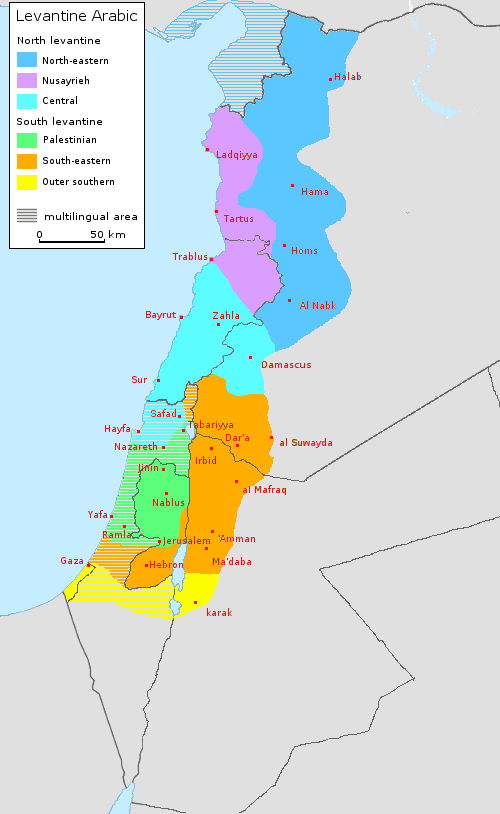
The Levantine map at a glance
- North Levantine — Lebanon and Syria (Beirut, Tripoli, Damascus, Aleppo, Homs, Latakia). Nearly identical grammar, very high mutual intelligibility.
- South Levantine — Palestine and Jordan (Jerusalem, Ramallah, Gaza, Amman, Irbid). Same family, small shifts in vocabulary and a few sounds.
- Edges — Hatay in southern Turkey, the Bekaa toward the Syrian desert, and large diaspora communities in Brazil, France, the US, Germany and the Gulf.
North Levantine: Lebanese and Syrian
Lebanese and Damascene Syrian are close enough that speakers rarely notice they are switching varieties. The most audible marker is the qaf: in both Beirut and Damascus it is usually pronounced as a glottal stop (ʾ), so qalb ("heart") becomes ʾalb. Lebanese leans toward a lighter, more raised vowel colour (imēle) — Beirut's kēn against Damascus's kān. Lebanese also carries the heaviest French and English layer of any Arabic dialect: everyday speech mixes bonjour, merci and ok without a second thought, which is part of why it feels approachable to European learners.
South Levantine: Palestinian and Jordanian
Grammar is essentially the same as the north — same b- verb prefix, same pronouns, same negation pattern. What shifts is pronunciation and a slice of vocabulary. Rural and Bedouin Jordanian often keeps a hard g for the qaf (galb), while urban Jerusalem and Amman speech uses the same glottal stop as Beirut. Verb forms like bidd- ("want") and hallaʾ ("now") are shared across the whole family.
North vs South — the practical differences
- Qaf: glottal stop in cities everywhere; hard g in Bedouin and rural Jordanian.
- Vowels: raised, "lighter" vowels in Lebanese; flatter in Palestinian and Jordanian.
- Loanwords: French and English in Lebanon; more English in Jordan and Palestine.
- Intonation: Lebanese has a distinctive sing-song rise that people recognise instantly.
- Everything else: grammar, sentence structure and 90%+ of vocabulary are shared.
Border regions blur the boundaries further: Tripoli sounds partly Syrian, southern Lebanon shares features with Palestine, and so on across every land border in the region. In practice a learner of any one Levantine variety follows conversations in all four countries — the gap is far smaller than the gap between Levantine and Egyptian or MSA.
Lebanese sits at the centre of the family: geographically between Syria and Palestine, culturally the region's biggest media exporter. Fairuz, Nancy Ajram, Lebanese cinema and TV drama travel across the whole Arabic-speaking world, so Lebanese speech is understood far outside the Levant — the widest passive reach for the smallest amount of work. If you want to learn it, see the Lebanese Arabic course page.
2. Egyptian–Sudanese
Egyptian Arabic (Masri) is the most-heard dialect in the Arab world thanks to a century of Egyptian cinema, TV and music — most Arabs from Morocco to the Gulf can follow it. Sudanese Arabic is closely related but distinct enough that some linguists treat it as its own family; it shares features with both Egyptian and Peninsular Arabic due to geography and history.
3. Maghrebi Arabic
Spoken from Libya west to Mauritania: Libyan, Tunisian, Algerian, Moroccan and Hassaniya (Mauritania and parts of Western Sahara). Maghrebi dialects have heavy Berber influence and French/Spanish loanwords, and they are the hardest group for eastern Arabs to understand cold — especially Moroccan and Algerian. Tunisian sits transitionally between Maghrebi and Levantine/Egyptian in feel, but is officially classified as Maghrebi.
4. Peninsular Arabic
The Arabian Peninsula splits into three internally distinct groups:
- Gulf Arabic: UAE, Kuwait, Bahrain, Qatar (and eastern Saudi Arabia). Their own recognizable subgroup.
- Saudi (Najdi / Hijazi): Central and western Saudi Arabia. Related to Gulf but distinct.
- South Arabian: Yemeni and Omani. Historically the most conservative Arabic varieties — even in antiquity, southern Arabia had its own South Semitic language family, and modern Yemeni/Omani reflect that older stratum.
5. Mesopotamian Arabic (Iraqi)
Iraqi Arabic and closely related border varieties in eastern Syria, southwestern Iran (Khuzestan) and southern Turkey. Distinct enough — heavy Aramaic, Persian and Turkish influence — that it's usually treated as its own group rather than lumped with Gulf or Levantine, even though it borders both.
6. Peripheral Arabic-official regions
Some countries have Arabic as an official language but with local varieties that are hard to classify neatly:
- Chad: not officially an Arab-League member in the same way, but Chadian Arabic is widely spoken and patterns closest to Libyan / Maghrebi.
- Djibouti, Somalia, Comoros: Arabic is an official or co-official language, but daily life happens in local languages (Somali, Afar, Comorian). Given historical Yemeni and Omani presence in the Horn of Africa and Indian Ocean coast, the Arabic used there likely carries South Arabian influence — this classification is debated among linguists.
The comparisons, one by one
This page is the map. Every pair people actually compare has its own page, with a table, examples and a direct answer to "which one should I learn?":
- Lebanese vs Egyptian Arabic — the two dialects you hear most.
- Lebanese vs MSA vs Egyptian — spoken dialect against the written standard.
- Lebanese vs Syrian, Palestinian and Jordanian — how much the accent really matters.
- Levantine vs Gulf Arabic (khaliji) — what is spoken in the UAE, Qatar and Kuwait.
- Levantine vs Iraqi Arabic — the eastern neighbour, with a different g and different loanwords.
- Levantine vs Maghrebi Arabic (darija) — the widest gap in the Arab world.
- Levantine vs Peninsular Arabic — Hijazi, Najdi and the Yemeni dialects.
MSA vs the dialects
Modern Standard Arabic (MSA, or Fusha) is the written and formal register — what you'll see in newspapers, religious texts, laws and news broadcasts. Everyone learns it at school; nobody speaks it at home. If you're learning Arabic to talk to people, you start with a dialect. If you're learning to read the news or the Quran, you start with MSA. Most practical learners layer them: dialect first for speaking, MSA later for reading.
Where to start
For most learners with no specific regional tie, we recommend starting with Lebanese Arabic — a North Levantine variety with huge media reach, wide diaspora, and 90%+ comprehension across the whole Levantine region. For the step-by-step route from zero to conversation, read how to learn Lebanese Arabic. If you want private lessons tailored to your goal, see the Arabic tutor page.
You don't need to be in Bucharest. Lessons run live on Zoom with a native Lebanese teacher, so you can learn from anywhere — private 1-on-1 lessons are available now and start whenever suits your timezone. New online beginner groups, taught in Romanian or in English, are open for registration — see the A1 online page for the dates and free places. Either way, the trial lesson is free — 30 minutes, 0 LEI, no obligation.
Start with a free trial lesson
30 minutes with a native teacher — online worldwide or in person in Bucharest. No obligation.