Blog · Grammar
Lebanese Arabic grammar: top 5 questions (b-, pronouns, word order)
Five grammar questions almost every Lebanese Arabic beginner asks — with short answers, examples, and clear comparisons to Modern Standard Arabic (MSA).
 Ibra · Published on 24 July 2026 · About 9 min read
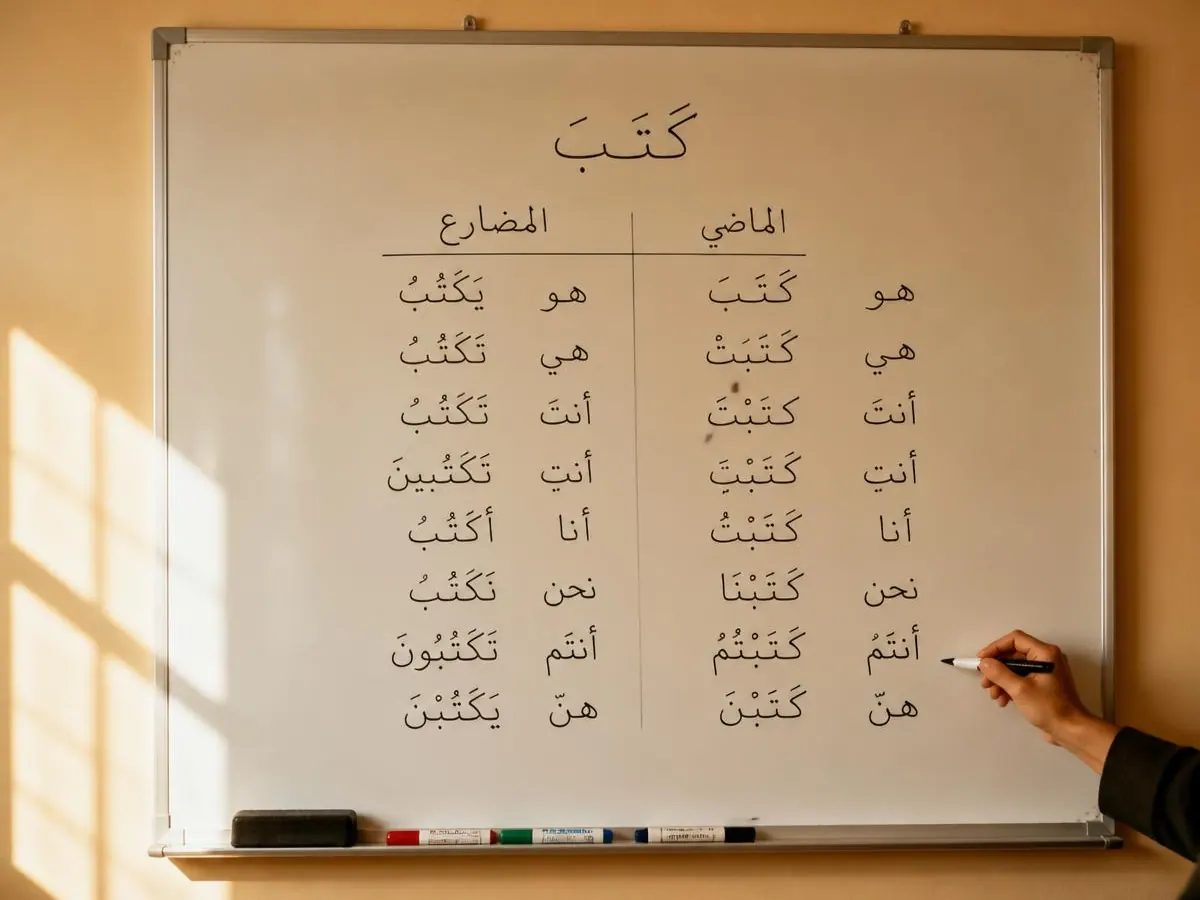
1. What does the بـ (b-) prefix do?
The بـ prefix marks the habitual or ongoing present tense — the closest equivalent to English "I do / I eat / I go". It's the single most common source of beginner confusion.
- bektob — I write (in general, I'm a writer)
- bshoof — I see / I'm seeing
- byekol — he eats / he's eating
- mnrooh — we go
Drop the بـ when the verb comes after a modal (want, can, must) — it becomes the plain subjunctive:
- baddi ektob — I want to write (no b-)
- fiyyi rooh — I can go (no b-)
- lazem nrooh — we must go (no b-)
Quick rule: real / habitual action → use بـ. After a modal or another verb → drop the بـ.
2. Past-tense verbs with attached pronouns
In Lebanese Arabic you conjugate the verb in the past, then stick the object pronoun directly onto the end. Using katab ("he wrote") as the base:
| Form | Meaning |
|---|---|
| katabt | I wrote |
| katabt-o | I wrote it / him (masc.) |
| katabt-a | I wrote it (fem.) |
| katab-lak | he wrote to you (m.) |
| katab-lek | he wrote to you (f.) |
| katabne-hon | we wrote them |
Two families of suffixes to memorise: the direct-object set (-o, -a, -hon, -ak, -ek…) and the beneficiary set (-lak, -lek, -lo, -la, -lna, -lkon, -lhon), which mean "to / for someone".
3. Personal and possessive pronouns
There are two sets you'll use in almost every sentence — the standalone personal pronouns, and the possessive suffixes that attach to nouns.
| Person | Personal | Possessive | Example (bayt = house) |
|---|---|---|---|
| I | ana | -i | bayt-i |
| you (m.) | inta | -ak | bayt-ak |
| you (f.) | inti | -ek | bayt-ek |
| he | huwwe | -o | bayt-o |
| she | hiyye | -(h)a | bayt-a |
| we | nihna | -na | bayt-na |
| you (pl.) | intu | -kon | bayt-kon |
| they | hinne | -hon | bayt-hon |
The same possessive suffixes double as object pronouns on verbs (see section 2), so learning them once unlocks a huge chunk of the grammar.
4. Word order: is Lebanese SVO or VSO?
In everyday speech, Lebanese Arabic is overwhelmingly SVO (subject-verb-object) — just like English or Romanian. Classical / MSA Arabic prefers VSO (verb first), but Lebanese speakers almost never talk that way.
- Lebanese (SVO): Ahmad byekol tuffaha — Ahmad eats an apple.
- MSA (VSO): Ya'kul Ahmad tuffaha — "Eats Ahmad an apple."
This one difference is a big reason Lebanese feels much more intuitive to European learners than MSA.
This is where the grammar closes
The structures above — conditional, passive, reported speech — are taught in full at B1, in a small group.
See level B15. How is Lebanese grammar different from MSA?
Lebanese Arabic keeps the same roots and most of the vocabulary of MSA, but drops the heavy grammar layer. Here's what's actually different:
| Feature | MSA | Lebanese |
|---|---|---|
| Case endings | Full system (-u, -a, -i) | None |
| Dual number | Separate dual form | Uses plural |
| Feminine plural verb | Separate conjugation | Merged into hinne |
| Present tense | aktub | bektob (b- prefix) |
| Future tense | sa-aktub / sawfa | rah ektob / ha-ektob |
| Negation | la / lam / lan / laysa | ma (+ suffix -sh in some regions) |
| Word order | VSO | SVO |
For a deeper comparison see Lebanese Arabic vs MSA vs Egyptian or the RO article Lebanese vs Standard Arabic.
None of this is taught as a table to memorise. The verb system, the conditional and reported speech are worked through in conversation across the A1–C2 levels.
Frequently asked questions
What does the "b-" prefix do to verbs?
It marks the ordinary present — what you normally do. Without it the verb expresses intention or subjunctive instead, and it is one of the most visible differences from Modern Standard Arabic.
Does Lebanese Arabic have grammatical cases?
No. The case endings of Modern Standard Arabic have disappeared from speech, which makes the dialect appreciably simpler to learn than the written form textbooks teach.
How do pronouns attach to words?
They stick to the end of the word as suffixes — on nouns they mark possession, on verbs they mark the object. The endings are the same in both cases, so you learn them once.
Read next
Want to practise this with a native teacher?
Book a free 30-minute trial lesson — online or in Bucharest.
Book the free trial lesson