Blog · Beginners
The Arabic alphabet: all 28 letters, with pronunciation
The 28 letters, their pronunciation and a reassuring truth: you don't need the alphabet to start speaking.
 Ibra · Published on 16 July 2026 · About 7 min read
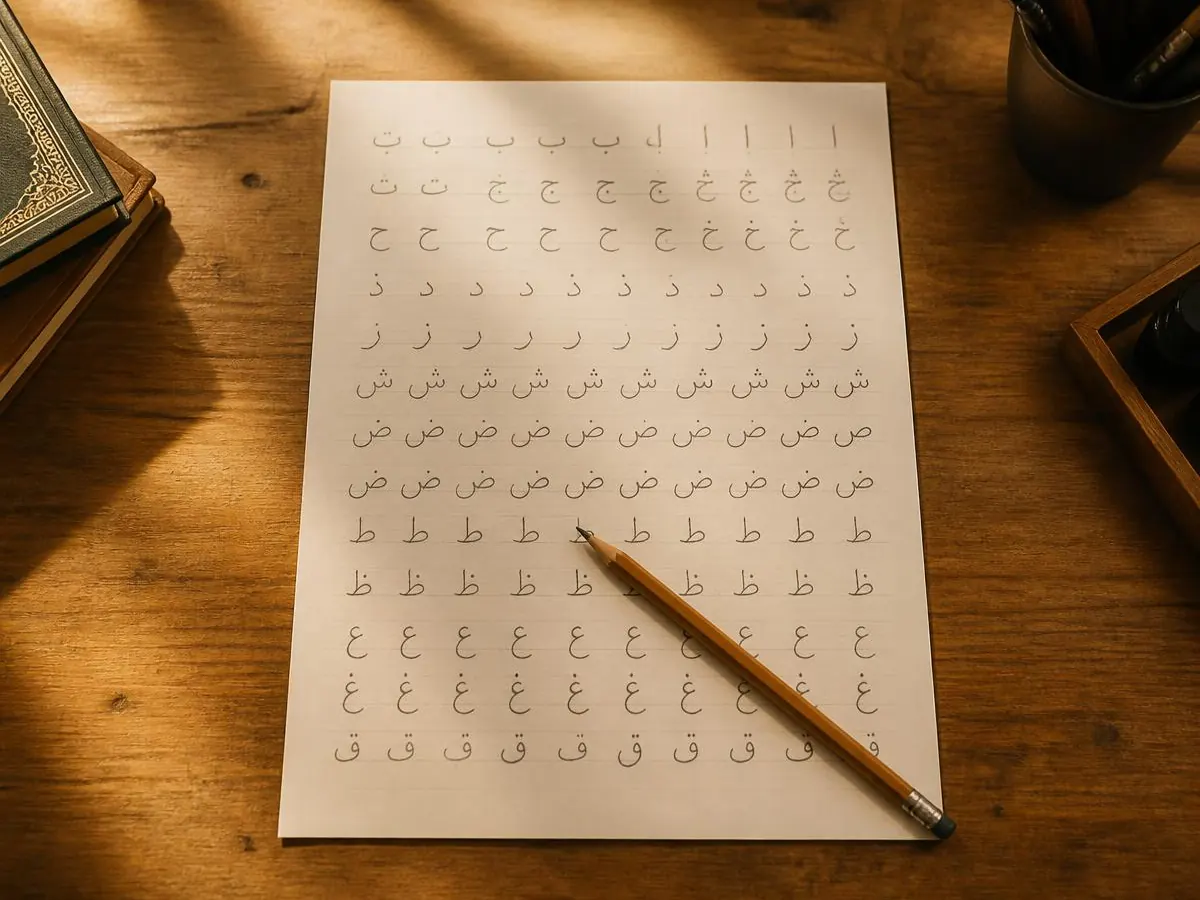
The Arabic alphabet looks intimidating at first, but it has a simple logic. It has 28 letters, is written right to left, and letters change shape slightly depending on their position in the word (start, middle, end). There are no upper- and lower-case letters.
The complete letter table
Below is each letter, its name and the approximate sound. 'Emphatic' means a sound pronounced more heavily, from the back of the mouth.
| Letter | Name | Sound |
|---|---|---|
| ا | alif | a / long â |
| ب | ba | b |
| ت | ta | t |
| ث | tha | th (as in 'think') |
| ج | jim | j (in Lebanese: 'j' as in 'journal') |
| ح | ḥa | harsh h from the throat |
| خ | kha | guttural h (like German 'ch') |
| د | dal | d |
| ذ | dhal | dh (as in 'this') |
| ر | ra | r |
| ز | zay | z |
| س | sin | s |
| ش | shin | sh |
| ص | ṣad | emphatic s |
| ض | ḍad | emphatic d |
| ط | ṭa | emphatic t |
| ظ | ẓa | emphatic z |
| ع | ʿayn | guttural sound (written '3' in Arabizi) |
| غ | ghayn | gh (like a French 'r') |
| ف | fa | f |
| ق | qaf | guttural q (in Lebanese often a glottal stop) |
| ك | kaf | k |
| ل | lam | l |
| م | mim | m |
| ن | nun | n |
| ه | ha | plain h |
| و | waw | w / long u |
| ي | ya | y / long i |
Short vowels are usually not written
An important quirk: in Arabic, short vowels (a, i, u) are marked with small signs above or below the letters, but in ordinary text they are not written. The reader infers them from context. That's why the table above is mostly consonants and long vowels.
Do you need the alphabet to speak?
No — and that's the good news. At the Lebanese Arabic Center we use the Oral First method: you start by speaking, with the help of Arabizi (Arabic written in Latin letters), without getting stuck on the alphabet: A1 and A2 are spoken only, and from B1 or B2 a group can add writing in Arabic letters only if all its students want it. You can hold whole conversations in Lebanese before writing your first letter.
When you actually need the alphabet
You need the Arabic script if you want to read texts, study Modern Standard Arabic, work with documents, or read religious texts. Realistically: 2-4 weeks of 20-30 minutes a day to recognise the letters, a few months to read fluently. You do not need it to hold a conversation — see learning Arabic without the alphabet, and the full Arabizi decoding guide. From B1 or B2 the alphabet is an option for groups whose students all want it, alongside speaking. In private lessons the alphabet is added on request — usually once you've started speaking. You can have it from the start, but then it can confuse your pronunciation. And note: the alphabet doesn't teach you standard Arabic (newspapers, books) — it's only the script; the language is still Lebanese.
Want to hear how it sounds?
30 minutes with a native teacher, free — online or in person in Bucharest.
Book the trial lessonHow to learn the alphabet more easily
- Group the letters by shape — many look alike and differ only by dots (ب ت ث).
- Learn to recognise them first, then to write them.
- Associate each letter with a word you already know from speaking.
- Practise with a teacher who corrects the guttural sounds (ع، ح، ق).
Want to see where you start? Take the free level test or read the complete beginner's guide.
Frequently asked questions
How long does it take to read the Arabic alphabet?
Recognising the 28 letters comes within a few weeks of short daily practice. Fluent reading takes longer, because most texts leave the short vowels out and you infer them from context.
Why aren't the short vowels written?
Arabic is normally written with consonants and long vowels only. The short vowels exist as diacritics, but they appear almost exclusively in the Quran, in poetry and in beginner textbooks. Speakers fill them in from context.
Do the letters look the same everywhere in a word?
No. Most letters take different shapes at the start, middle and end of a word, plus a standalone form. They are variations of the same letter, not new ones — after a few days the eye connects them automatically.
Do I need the alphabet to speak Lebanese?
Not in order to speak. Lebanese is primarily a spoken language, and at the start it is written in arabizi (Latin letters). The alphabet becomes useful when you want to read menus, signs, messages or Modern Standard Arabic.
Read next
Ready to start speaking Lebanese Arabic?
A free trial lesson with a native teacher — online or in person in Bucharest.
Book a free trial lesson