The Phoenicians and Lebanese identity
"Are Lebanese people Arabs?" Politically, yes. By origin, the Lebanese are an Arabized nation descended primarily from the native people of the Levant. On the coast of today's Lebanon, those ancestors have a name everyone knows: the Phoenicians.
Published on 4 October 2026 · About 6 min read
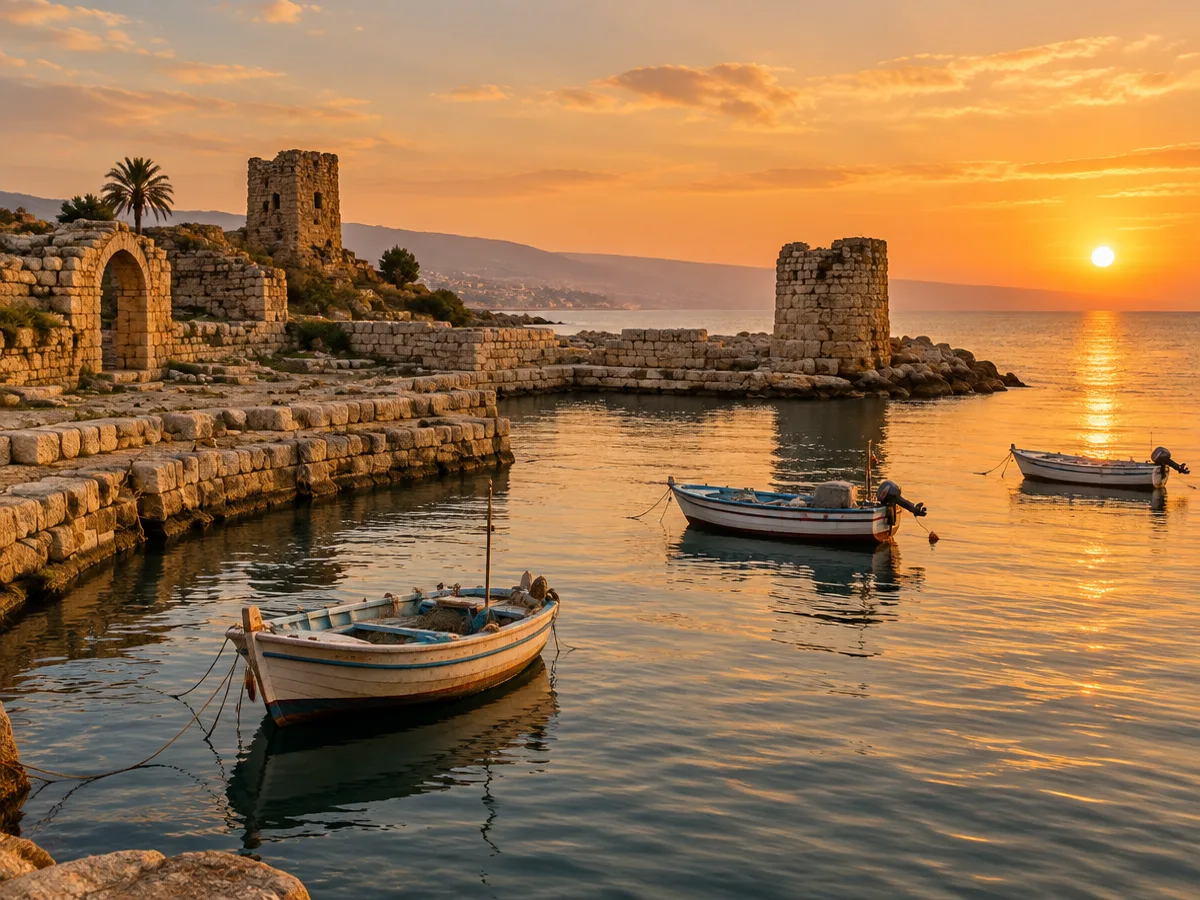
1. Canaanites and Phoenicians
"Canaanites" is the collective name for several related peoples who lived in the Levant in the Bronze Age and spoke related Semitic languages. Those who lived on the land of today's Lebanon, mostly along the coast, are the ones history calls Phoenicians. They did not form one state but a chain of independent city-states: Byblos (Gebal), Berytus (Beirut), Sidon, Tyre, and Tripoli to the north — called Athar by some sources. Inland, Baalbek still carries the name of the god Baal.
Phoenicia stretched along the coast from Arwad, in today's Syria, south to around Acre. Further north, Ugarit, near today's Latakia, had a closely related Canaanite culture.
2. Why "Phoenicians"
They did not call themselves that. The name comes from Greek, most likely from phoinos — dark red, purple — the colour of Tyrian purple, a dye extracted from murex sea snails. It took thousands of snails for a little dye, which made it extremely expensive and turned it into the colour of kings and emperors. In Akkadian texts the region appears as Kinahhu; some scholars link that name to purple as well, but this remains a hypothesis.
3. Sailors, traders and the alphabet
The Phoenicians sailed the whole Mediterranean, founded colonies — Carthage, by tradition founded from Tyre — and traded cedar wood from Mount Lebanon, glass and purple cloth. Their greatest legacy is the alphabet: a short set of letters, one per sound, that the Greeks adopted and passed on to the Romans. One of the oldest inscriptions in it is on the sarcophagus of King Ahiram of Byblos.
4. What genetics says
In 2017, The American Journal of Human Genetics published a study of roughly 3,700-year-old DNA from five people buried in Sidon. Compared with Lebanese people today, it found that about 93% of their ancestry comes from these Bronze Age Canaanites. Empires, languages and religions changed many times; the population largely stayed.
5. From Phoenician to Arabic
In the Greek and Roman period the people of the coast and the mountain became Christian and spoke Aramaic, written as Syriac. After the 7th century they were gradually Arabized, and some became Muslim. That is why Lebanon today is part of the Arab League and speaks Arabic — and why Lebanese Arabic still carries Syriac words. Many Lebanese put it simply: the language changed, but we are the same people as our ancestors.
Want to speak the language of Lebanon today?
We teach the Lebanese dialect with a native teacher. Groups A1–C2 and 1-on-1 lessons.
See the coursesRelated: The Syriac inside Lebanese Arabic · Saint Ephrem and the Maronite Church · Lebanese culture.
Frequently asked questions
Are the Phoenicians and the Canaanites the same people?
The Phoenicians are the Canaanites of the coast of today's Lebanon. "Canaanites" is the wider name for several related peoples of the Levant; "Phoenicians" is the name the Greeks gave to those of the coastal cities.
What does the 2017 DNA study show?
Published in The American Journal of Human Genetics, it compared roughly 3,700-year-old DNA from Sidon with Lebanese people today: about 93% of their ancestry comes from the Bronze Age Canaanites.
Did the Phoenicians invent the alphabet?
The 22-letter Phoenician alphabet is the ancestor of the Greek alphabet and, through it, of the Latin one — and also of Aramaic script, from which Syriac and Arabic writing descend.
Read next
Ready to start speaking Lebanese Arabic?
A free trial lesson with a native teacher — online or in person in Bucharest.
Book a free trial lesson